

Healthy and Unhealthy Coping Mechanisms: The Beautiful Ways We Learn to Survive
- mockwitzmedia
- Jun 30
- 6 min read
The pale light from the refrigerator spills onto the kitchen tile, and I stand there longer than necessary, staring at leftovers I do not want and strawberries I’m not hungry for.
There are certain kinds of hunger that have nothing to do with food.
I think most of us eventually discover that what we crave and what we need are often two very different things.
And still, I find myself opening the refrigerator - sometimes multiple times in the same hour, as if something new has magically appeared.
The reality is I’m not looking for the snack. I’m looking for the comfort the snack provides.
We all have our own version of the refrigerator, that place we return to when something inside us is asking to be soothed.
For some, it is the second glass of wine after everyone has gone to bed. For others, it is online shopping, endless scrolling, another degree, another relationship, another project, another episode - another reason not to sit quietly in the company of ourselves. Sometimes it is perfectionism disguised as ambition. Sometimes it is busyness disguised as purpose. Sometimes it is taking care of everyone around us because attending to our own ache feels far too dangerous.
We call these things bad habits. We call them flaws and weaknesses. We make promises to stop. We criticize ourselves for lacking discipline. We put things off for one more day.
What if the habits we are trying so desperately to outgrow or altogether quit are not evidence of our failures?
What if they are evidence of our survival?
Psychologists call these strategies coping mechanisms.
A coping mechanism is simply anything we do to help ourselves survive discomfort, stress, uncertainty, grief, fear, loneliness, or emotional pain.
Some coping mechanisms are healthy and restorative. They help us move through difficult experiences while remaining connected to ourselves and to others. We take a walk. We call a friend. We write in our journals. We cry. We pray. We ask for help.
Other coping mechanisms help us survive too, but they do so by helping us avoid, numb, control, or

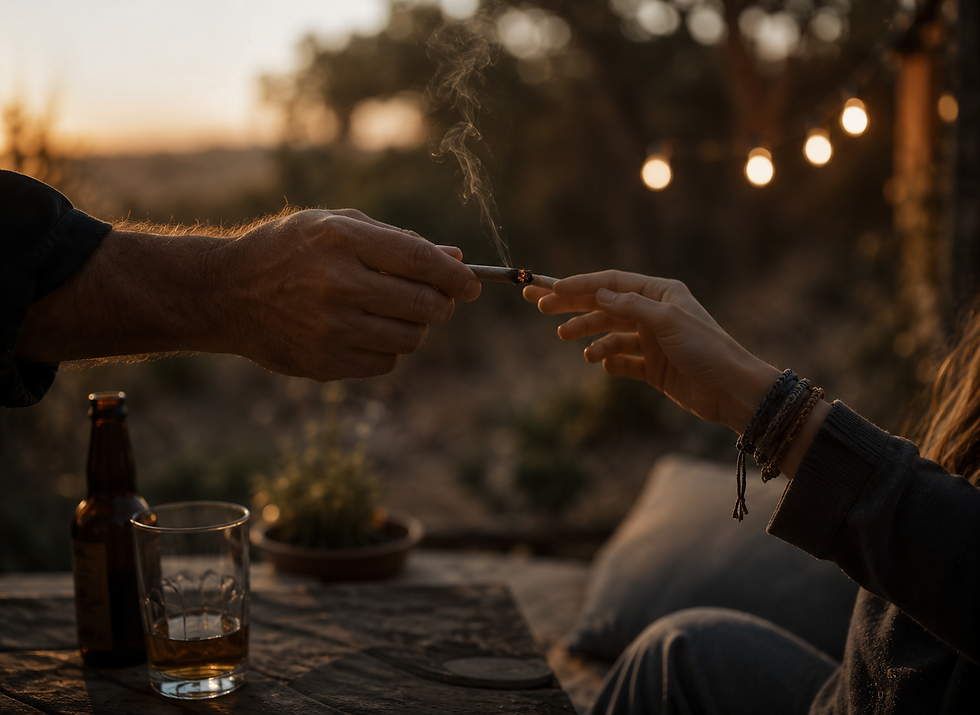
escape what we are feeling. We overwork. We overeat. We drink too much, smoke, or pop pills. We people-please. We withdraw. We gamble, We become endlessly productive. We chase perfection. We stay busy because stillness feels like standing in an empty room with our own grief.
The thing about unhealthy coping mechanisms is that they almost always begin as acts of protection.
Most of them begin as ingenious acts of self-protection.
Years ago, I came across a sentence by physician and trauma expert Gabor Maté that seemed to open a hidden door in my mind:
The question is not why the addiction, but why the pain.
I wrote it down immediately because I knew it wasn't really about addiction.
It was about all of us.
The woman who cannot stop achieving may have been the child who learned that excellence earned praise and praise felt dangerously close to love.
The person who does everything alone may have learned early that needing others often led to disappointment.
The caretaker who anticipates everyone's needs before they are spoken may have grown up in a home where emotional weather changed without warning and vigilance became a form of safety.
The child who disappears into books, imagination, or work may have discovered that becoming small was the surest way to survive a world that felt too large.
None of these responses is accidental.
They are adaptations.
They are the beautiful ways we learned to survive.
And because they helped us survive, we often become fiercely loyal to them. Which is another reason change can feel so fucking hard.
And sometimes they are not even entirely ours.
Families pass down much more than eye color and old recipes.
They also hand us survival strategies in the form of coping mechanisms for pain. One generation learns to stay busy because stillness feels dangerous. Another learns to avoid conflict because anger was frightening. Another learns to achieve because achievement brought praise and praise felt like love. Before long, these strategies stop looking like coping mechanisms and start looking like personality.
The women in your family may have taught you that self-sacrifice is love.
The men may have taught you that emotions are dangerous and should be hidden.
You may have inherited anxiety from a grandmother who lived through instability, hypervigilance from a parent who never felt safe, or people-pleasing from generations of women who had to keep the peace in order to survive.
I often think of inherited coping mechanisms as old family heirlooms.
You carry them because everyone before you carried them.
At some point you need to stop and ask whether they still belong in your life.

A coping mechanism becomes unhealthy when the thing that once protected us begins to cost us our peace, our relationships, our health, or our ability to fully participate in our lives.
I know for me, years of slight disconnection became a safe place. The edges were softer and I felt calm floating slightly outside of things and people.
A glass of wine to celebrate is one thing. A nightly bottle of wine because you cannot tolerate your own thoughts or sit in feelings of discomfort is something else. It is easier not to acknowledge an unhealthy coping mechanism when the mechanism itself distances you from yourself.

Being responsible is one thing. Believing you must hold the entire world together because everything will fall apart without you is something entirely different.
The line between healthy and unhealthy is not always found in the behavior itself.
It is often found in the question:
Is this helping me move through my life, or is it helping me avoid it?
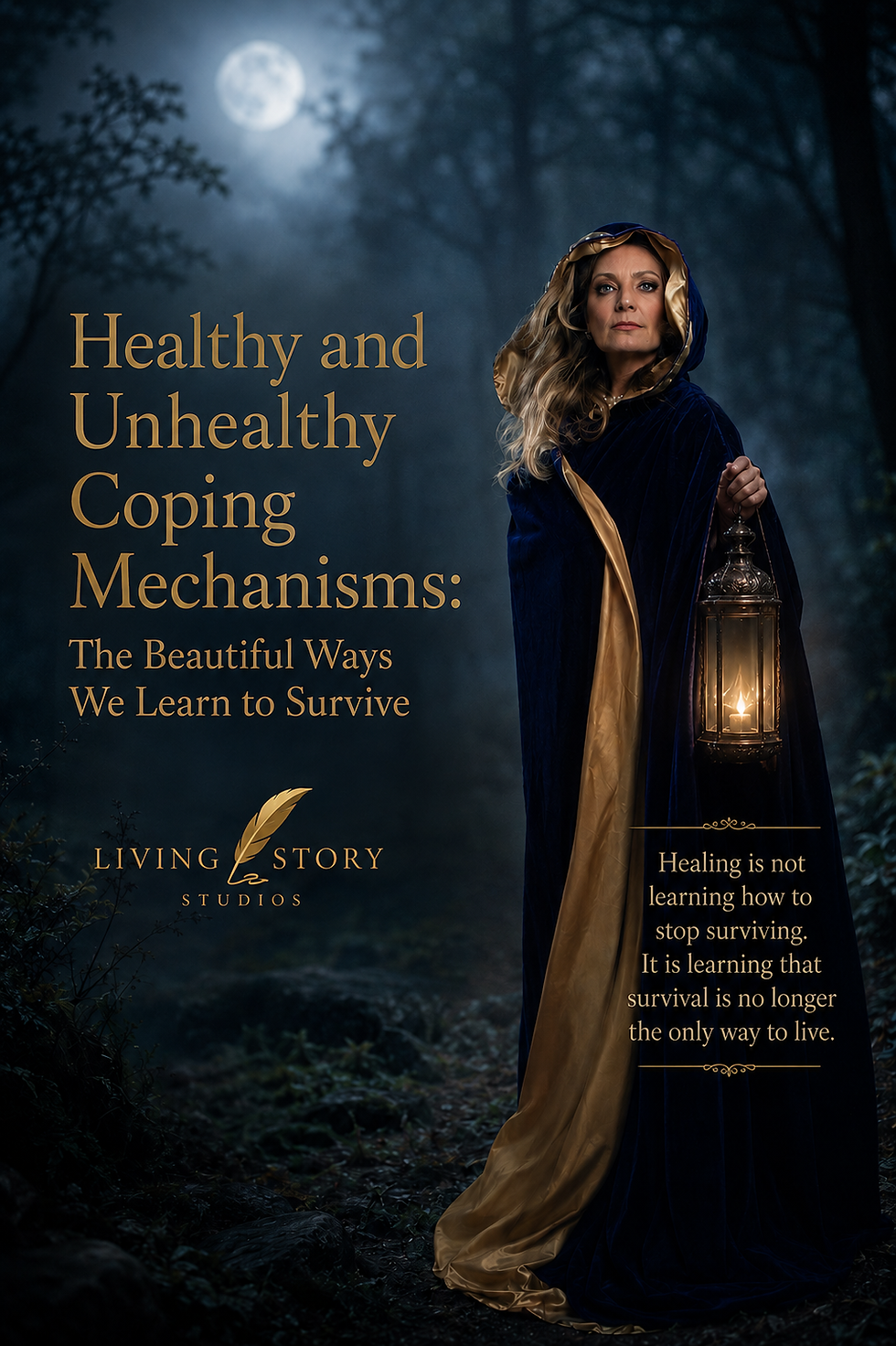
I think of coping mechanisms as lanterns.
Imagine a little girl walking through a dark forest carrying a lantern in her hands. The light is small, but it is enough. It helps her find her way. It keeps her from stumbling. Over time, she begins to believe that the lantern itself is the reason she survived the night.
Then one day she emerges from the trees.
The sun is rising.
The world is bathed in morning light.
And still, she clutches the lantern.
Not because she needs it anymore, because she cannot imagine who she would be without it.
That is what it feels like to leave behind an old coping mechanism.
Even one that hurts us, exhausts us, and no longer fits. Because it has been there with us, for us, and loved us in only the way a good addictive coping mechanism can.
Saying goodbye to a coping mechanism can feel, in some small and tender way, like betraying the person we once were.
The child who needed it.

The woman who survived because of it.
Healing asks something different of us.
It asks us to honor the lantern and then gently set it down.
It asks us to say:
Thank you for carrying me through the dark.
You do not have to carry me anymore.
This is where healthier coping begins.
Not with shame.
Not with force.
Not with another list of things to fix.
But with curiosity.
What am I really hungry for?

What feeling am I trying not to feel?
What old fear still believes it is protecting me?
And what might happen if I met that fear with tenderness instead of judgment?
Perhaps I am not hungry for food at all.
Perhaps I am hungry for rest.
For comfort. For grief. For connection.
For permission to be cared for instead of always being the one who cares for everyone else.
For the courage to believe that the sun has already risen.
There are evenings when I still stand in front of the refrigerator.
I still search for something unnamed.
But now I pause.
I close the door. I place my hand against the cool surface and ask myself a different question.
Not, What is wrong with me?
But rather, what beautiful thing once helped me survive that I no longer need to carry?
I think healing may be exactly that.
Not becoming someone who no longer copes.
But becoming someone who understands why she learned to in the first place and, with great tenderness, chooses a different way to live. I know this because I have spent enough years trying to rip old coping mechanisms from my hands, only to discover that healing rarely works that way. We cannot simply remove something that once protected us and leave the empty gaping space.
It needs to be slowly replaced by another. Something gentler. Something truer. Something that teaches our nervous system that safety and joy can exist in the same room.
A method that feels less like the known security of surviving.

And more like finally coming home to herself. Ironically, this isn’t something that can be found in the refrigerator but the nourishment that only you can provide to yourself.
As I get acquainted with this older, quieter, and perhaps truer version of myself, I have started returning to
simple things. Putting on my favorite song and singing into my hairbrush and dancing in my living room where I specifically created space to let loose.
I’m learning that healing isn’t about becoming someone entirely new. It’s found in remembering the parts of ourselves that existed before survival became our primary occupation.
What did you love before survival became your full-time job? I suspect the answer may be waiting there, gently calling you home. I bet it’s something gooood!


Comments